
Introduction
CLOs are a relatively recent innovation, but the investment principles that underpin them have developed over generations. This article traces the ideas, and the thinkers behind them, that continue to shape CLO portfolio management today.
Concentration
The well-known saying “don’t put all your eggs in one basket” is attributed to Miguel de Cervantes in his famous book Don Quixote as long ago as 1605. So, is Cervantes saying that it would be better to carry the eggs in two baskets? Or is the issue more about the fragility of the eggs than the number of baskets? The full quote is “it is the part of a wise man to keep himself to-day for to-morrow, and not to venture all his eggs in one basket.” So, there is not only a message here about not carrying only one type of asset in a single basket but also about making more than one journey.
Investment Strategies
A variety of investment strategies have developed over the last hundred years.
- Value investing was pioneered by Benjamin Graham and practiced by Warren Buffett. This involves deep research to try to identify under valued assets and then holding them for a long period.
- Contrarian investing which is investing against the direction of the market.
- Momentum investing which involves investing in the direction of the market.
- Growth investing which involves looking for the “winners”.
- Income investing where the focus is on regular cash flow from dividends or coupons.
- Index investing which aims to replicate market performance.
There is still a risk that losses could exceed gains, especially if the assets are susceptible to similar risks.
Diversification
Modern Portfolio Theory
In 1952, Harry Markowitz published his seminal paper developing Modern Portfolio Theory (MPT); he was later awarded the Nobel Prize in Economics in 1990 for this work. He suggested that buying a larger number of assets improved the overall outcome if those assets were not subject to the same risks (i.e. not correlated).
MPT is the source of many familiar phrases still used in the investment community today such as:
- Risk vs reward
- Risk tolerance
- Benchmark
- Efficiency curve
- Beta
- Alpha
- Systematic risk
- Unsystematic (or idiosyncratic) risk
MPT is essentially a passive investment approach.
It had its critics because it applied the efficient market hypothesis (i.e. all information is known to all participants, people behave rationally and there are no transaction costs).
Other perceived weaknesses were that correlations between assets would not change and that gains and losses were weighted the same way in the eyes of investors. Of course, in the real world, people behave differently, things change over time and investors worry more about the risk of losing money than the prospect of making money.
Post Modern Portfolio Theory (PMPT)
Subsequently, research by Peter Fishburn (1977) and Hal Forsey and Frank Sortino (1981) started to address these deficiencies.
It was in 1993 that Brian Rom and Kathleen Ferguson pulled together this research and coined the term Post Modern Portfolio Theory (PMPT). PMPT introduced the idea of active management to mitigate downside risk.
We can start to see the genesis of the CLO investment model in PMPT. Before we progress this debate further, we will revisit what CLOs do.
CLO Portfolio Management
CLOs invest in assets commonly known as Broadly Syndicated Loans (BSLs). These are loans to large corporations which are typically owned by Private Equity Firms. BSLs are tailored to the requirements of the borrower and generally negotiated and underwritten by one or more arranging banks and then sold to a range of investors, including CLOs.
CLO managers select which loans to buy based on the work of a team of credit analysts (see forthcoming CLO Insights – A Day in the Life of an Analyst).
The investment recommendation from the analyst is reviewed by an investment committee. Portfolio managers make sure that each new asset meets the CLO eligibility criteria and is a good “fit.” Each asset is given a weighting according to its impact on the portfolio as a whole.
By their nature, CLOs are more concerned with the downside risk of a loan defaulting than with its upside, because the “upside” of investing in a loan is inherently limited. The loan is typically repaid at par (i.e. 100%), with only modest additional gains available through secondary market trading.
It’s clear that PMPT principles underlie the CLO model and indeed the CLO documentation pre-determines the characteristics of the assets that are eligible to go into the portfolio (see CLO Insights – Collateral Quality Tests and Matrices).
Securitisation
Lewis Ranieri pioneered the concept of securitisation in the 1970s. It involves dividing investment risk into two or more tranches.
In the CLO market, these tranches (rated AAA to single B) are designed to suit the investment needs of a variety of investors. In a typical CLO structure, the rated notes represent c. 90% of the funding, with equity representing the remaining c. 10%.
Securitisation technology developed over the subsequent years, and the rating agencies were able to collect a lot of empirical data on the underlying BSLs to inform their models.
Defaults
Despite the skills of the research analysts, some of the loans may default. This could be because of non-payment of principal or interest, or bankruptcy.
Research shows that the market rate of default for BSLs is c. 2% p.a. Within CLO portfolios, however, this rate has generally been lower, supported by asset selection and active management.
If an investor buys AAA-rated notes which equate to c. 60% of the funding structure, there is statistically a very low risk of loss. In fact, this is borne out by rating agency research showing that no AAA-rated CLO note has defaulted since the modern CLO market began in the 1990s.
However, lower down the structure investors are taking more risk until, right at the bottom, the “equity” tranche is potentially exposed to all of the defaults.
Why would anyone want that?
To find out, please read on. The next two sections explain how risks are managed and returns are achieved.
Losses are Typically Contained
Even if a borrower defaults, evidence shows that actual losses are generally quite low because, as senior secured creditors, CLO lenders rank ahead of unsecured and subordinated creditors in an insolvency.
The recovery assumption for BSLs is 70% of principal, which translates to 0.60% p.a. of losses to the portfolio assuming a 2% p.a. default rate.
CLOs are also protected by over-collateralisation and interest coverage tests in the CLO documentation. If a test is breached, interest and principal proceeds that would otherwise be paid to the equity (and, in some cases, more junior rated notes) are instead redirected to pay down the senior notes, reducing leverage and protecting the more senior tranches before losses are actually incurred (see CLO Insights – The Waterfall).
Leveraged Arbitrage
The underlying loans pay interest on a regular basis. The resultant cash flows are used to pay investors in the CLO notes in order of priority.
The weighted average cost of a typical CLO structure is approximately Euribor plus 2% (E+2% p.a.) compared to the income generated from the assets, which is approximately E+3.5%. The difference is referred to as the excess spread or arbitrage.
This excess spread is due to the “equity” investors to compensate them for taking the default risk in the portfolio.
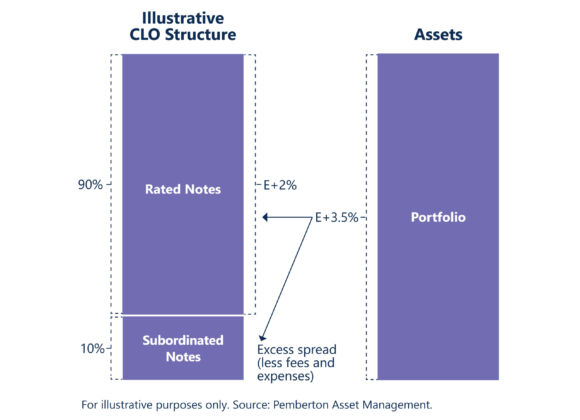
Because of the structure of the CLO notes, the excess spread of the entire portfolio is paid to investors who have subscribed only 10% of the structure. Assuming that the manager does a good job and minimises losses, the CLO should generate leveraged returns to the equity in the mid-teens. Part of the excess spread is also used to pay the CLO manager’s fees.
Conclusion
The CLO model is underpinned by post-modern portfolio management theory including informed asset selection, diversification and active management within a rating agency framework. Well established securitisation technology serves to allocate risk and return appropriately.
We have come a long way from the eggs in Cervantes’ basket.
Download On the Shoulders of Giants
For further information or if you have a specific query,
please get in touch.