
Macroeconomic uncertainty and supply chain disruption make for a compelling investment case, despite idiosyncratic credit events.
The following article is based on Pemberton’s understanding of the market at the time of publishing.
Introduction
Working capital finance continues to offer investors an attractive proposition, diversifying portfolios and introducing liquidity, a case that has arguably strengthened in an environment of macro-economic uncertainty and supply-chain disruption. This paper interrogates the fundamentals and structural characteristics that underpin the asset class and explain its resilience.
1. Fundamentals vs. Sentiment
The investment case for working capital finance has grown more compelling, built on solid fundamentals and amplified by the supply-chain disruption that has driven corporates to lean more heavily on the asset class. These types of facilities are commonly used by large corporates (>$500m turnover) and roughly half of mid-cap corporates ($50-500m turnover) in Europe and North America to help facilitate their day-to-day trade, within a global trade finance market of approximately $6.5 trillion annually.1 This equates to over 150,000 companies in the large and mid-cap segment across Europe and North America.2
The asset class is short-dated and self-liquidating, with generally uncommitted facilities that do not extend beyond one year and typically repay within 90 days, and can benefit from structural seniority, often performing in practice super-senior to the rest of the capital structure. This profile is what makes the relative-value case striking: the asset class can offer non-investment grade returns for risk that is characteristically closer to investment grade, as evidenced by historical default rates.
In 2025, two high-profile bankruptcies (First Brands Group, Tricolor) have understandably drawn investor attention.3 But these appear to be isolated, idiosyncratic risk events involving alleged fraud at individual companies, and they represent a marginal fraction of an expansive market rather than a broader concern about the asset class itself.
This paper looks beyond current market sentiment, which for discerning investors, has created an opportunity to engage with the asset class on attractive terms. The following chapters set out the fundamental strengths of working capital finance, and why demand for it is rising from the perspective of both borrowers and institutional investors.
2. Structural Features of Working Capital Finance
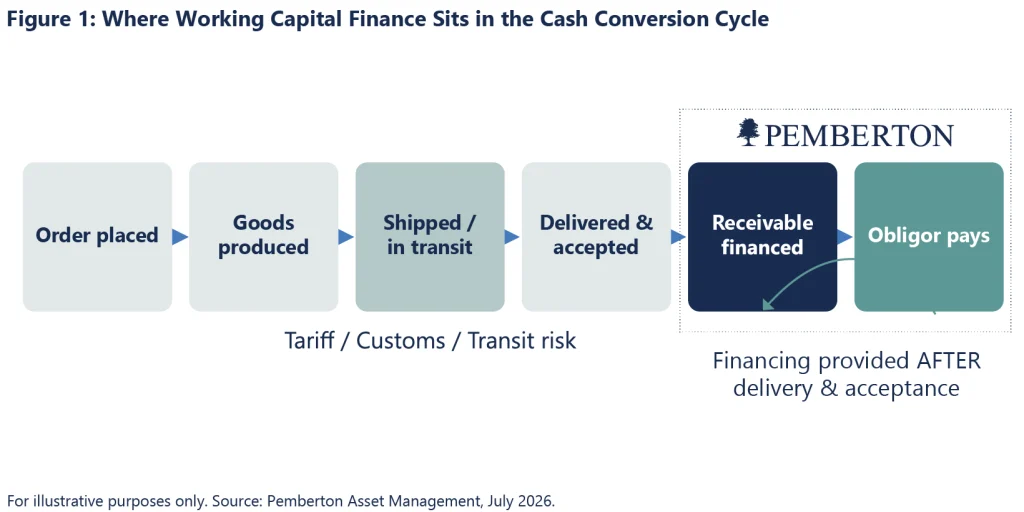
Working capital finance unlocks the potential liquidity of everyday commerce: the cash companies have tied up in paying suppliers, maintaining inventories, and collecting payments from customers.
Working capital finance spans three related forms.
Receivables financing can take the form of advances against the value of invoices owed from buyers, or may involve the purchase of those invoices at a discounted value. Payables, or supply-chain, finance pays a company’s suppliers early at a discount while the buyer settles the full amount at maturity. Inventory and asset-based facilities provide secured, often super-senior funding against inventory and potentially receivables.
Two structural features run through all financing variants. First, the loan asset is short-dated and typically self-liquidating: it repays itself out of an identified cash flow, within weeks or months, rather than relying on EBITDA generation, refinancing or asset sales.
3. Resilient by Design: Short Duration and Self-Liquidation
The defining feature of the asset class is the ultra-short tenor of the underlying financings. A working capital facility by its very nature does not have a maturity beyond one year, and a typical transaction frequently liquidates within 90 days. This is a fraction of the tenor of credit instruments such as corporate bonds, or broadly syndicated loans.
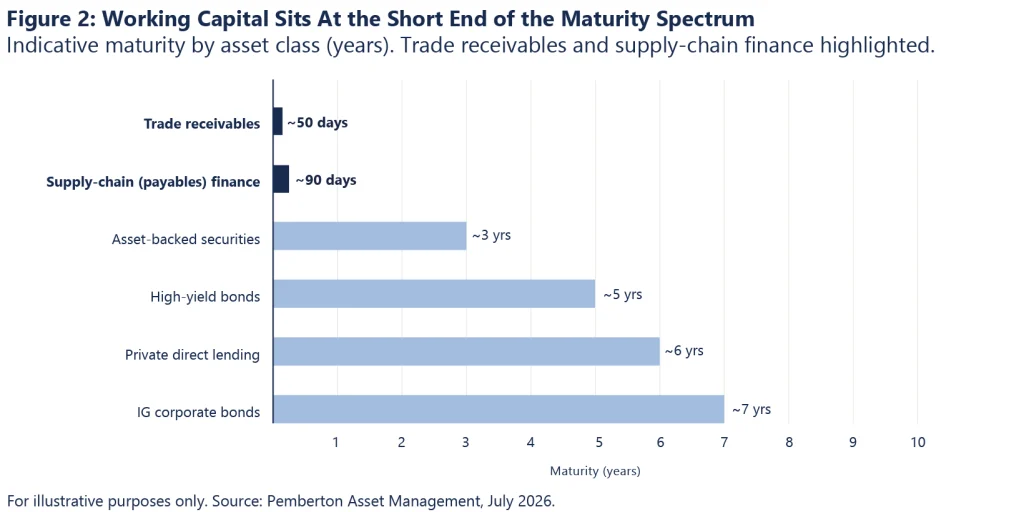
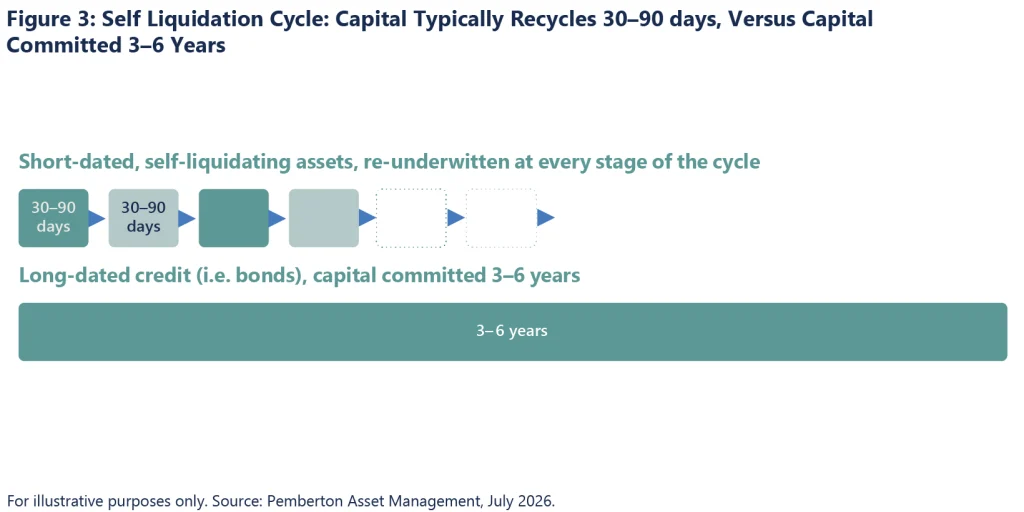
Self-liquidation compounds the effect. Because each funding (invoice discounting) under a working capital facility repays itself and enables capital to be redeployed every 30, 60, or 90 days, the book is continuously maturing and re-pricing to reflect current conditions. In a volatile market that has three practical implications: an investor is rarely far from par, because the asset is always close to its own maturity; risk can be re-priced quickly, as new invoices are presented for funding within weeks; and the investor is not a forced seller, because repayment/liquidity is derived from the ordinary course of business, i.e. the repayment of trade invoices rather than a repayment based on a financial obligation’s maturity or an asset disposal.
4. The Value of Short-Dated Instruments in a Credit Event
The failures that have weighed on sentiment are, on inspection, idiosyncratic: stories about individual companies and managers, not evidence that short-dated claims on delivered goods have become structurally unsound. The historical loss data bears this out. Data obtained related to short-term export credit recorded an average claims ratio of roughly 13 basis points across 2020 to 2025, a window that includes the pandemic dislocation, emerging market risk and the 2025 tariff disruption.4
There is a structural reason losses stay low in a credit event, and it is specific to the asset class. When a company runs into trouble, a central objective for the company and its senior creditors alike, is to preserve its “going concern” status, because a functioning business is worth far more than a liquidated one. To remain a going concern, the company must keep paying its trade creditors. That dynamic works directly in favour of working capital solutions: short-term trade obligations will likely to continue to be paid even as other claims are impaired.
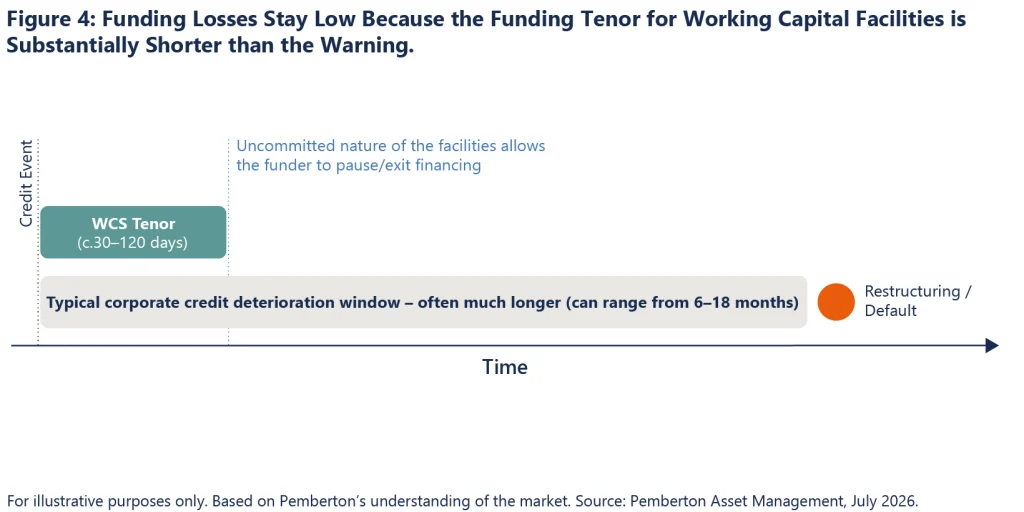
The timing reinforces this. A typical corporate credit deterioration plays out over many months, far longer than a 30-to-120-day funding tenor, so outstanding exposure self-liquidates well before a default crystallises.
Close monitoring is key and signals risks early.
Monitoring payment behaviour across the book and acting on early deterioration while the option to stop funding still exists. Because facilities are uncommitted, a funder watching payments in real time can simply decline to finance the next invoice and let outstanding exposure run off.
5. A Striking Relative Value Case
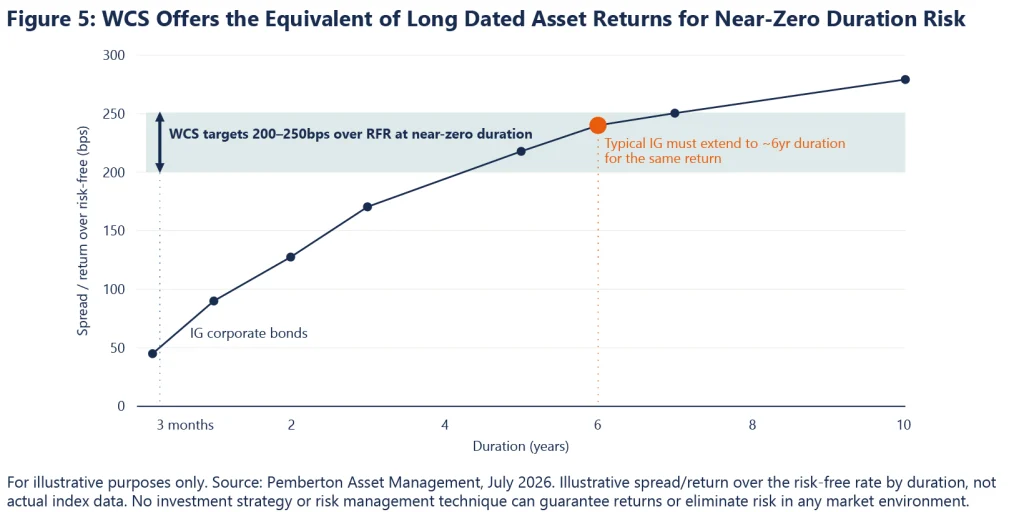
This short, self-liquidating profile is what makes the risk profile and relative-value case striking. Pemberton’s Working Capital Solutions strategy targets a return of approximately 200 to 250 basis points over the risk-free rate, a level normally associated with taking considerable duration risk, while the underlying exposure is short-dated and structurally low-risk.5
To earn a comparable return from investment-grade corporate bonds, an investor would typically have to extend the tenor of such financing out to around circa six years, accepting the price volatility and interest-rate sensitivity that come with it.
Put simply, the asset class can offer non-investment-grade returns for risk that is characteristically closer to investment grade, as evidenced by historical default rates. That combination, a long-duration return potential for short-duration risk, is an important consideration when considering the investment case.
6. Ongoing Supply Chain Disruption Increases Demand for Working Capital Finance
Supply-chain disruption has become a constant challenge since 2020. Tariffs, geopolitical tension, sanctions and rerouting have made cross-border trade more complex and less predictable. Firms are diversifying suppliers, relocating production and shifting from “just-in-time” to “just-in-case” inventory. Each of these moves consumes working capital. Longer or duplicated supply lines to fund, more inventory to hold, and wider gaps between paying suppliers and collecting from customers.
Crucially, this demand has risen through every recent shock rather than in spite of them (Figure 6). As successive disruptions have materialised, the pandemic, post-Brexit trade barriers, the Russia–Ukraine conflict, Red Sea and Suez disruption, the Baltimore bridge collapse, US tariffs and closure of the Strait of Hormuz in 2026, the financing required to keep goods moving has grown, not shrunk.
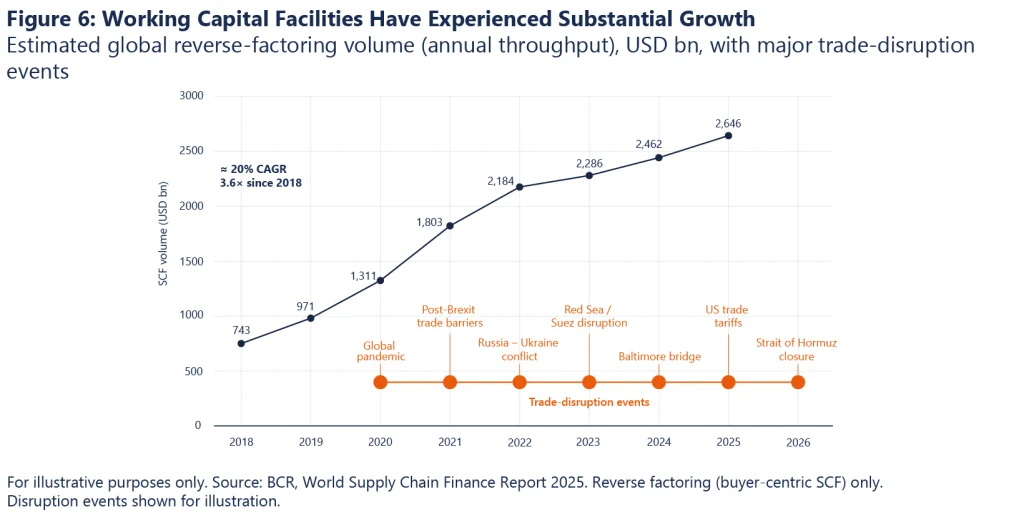
We believe this is a structural tailwind, not a short-term trend and it is likely to grow further. The build-out of AI and the data centre and semiconductor supply chains underpinning its growth, is a vast, capital-and inventory-intensive industrial effort, and one that is likely to increase demand for working capital financing further and dramatically as companies fund longer lead-times, strategic inventory and the components needed to secure critical capacity.
7. Volatility Can Create Opportunity
When some providers retreat and sentiment cools, the investors and managers who remain engaged tend to face a more favourable environment: less competition for assets, wider spreads, stronger structural protections and better asset selection. Periods of disruption widen the opportunity set for disciplined capital even as headline risk rises.
It also matters where on the trade-finance spectrum a strategy sits. Exposure to disruption is far from uniform: commodity and goods-in-transit strategies are the most exposed, while diversified, short-dated, post-delivery portfolios financing medium and large companies are among the least. Position, not just the asset class, determines whether volatility is a threat or an opportunity.

8. Conclusion
The case for working capital finance is a case about fundamentals. The asset class is short-dated, self-liquidating and can be structurally senior in practice. It has experienced very low losses through the cycle and offers attractive risk-adjusted returns which compare with longer dated investment-grade instruments. Far from being undermined by a more volatile, more disrupted world, demand for working capital is rising and the industrial developments of our time are likely to drive the increased demand further.
For investors, that combination of resilience and rising demand makes for a compelling investment case, complementing a well-diversified portfolio and adding a potentially differentiated, liquid, low-volatility, floating-rate source of returns.
Why Pemberton
- Pemberton is an established multi-strategy private credit manager with over $32.5bn in AUM and serves over 375 investors globally6
- Pemberton’s Working Capital Solutions strategy, established in 2019, is a leading non-bank working capital lender and today manages in excess of $2.2bn in commitments
- Since inception, Pemberton has processed in excess of $35bn of working capital financing volumes
- Dedicated in-house WCS direct origination team, leveraging the broader Pemberton origination platform, together with our bank and platform relationships
- Deep credit expertise with dedicated independent credit risk analysis resources and an enhanced corporate governance framework
Download Working Capital Solutions: Back to Fundamentals
For further information or if you have a specific query,
please get in touch.

1Based on Pemberton’s understanding of the market, August 2026. World Economic Forum – Annual Meeting data.
2US large and mid-cap company numbers according to Dun & Bradstreet business counts published by the NAICS Association, “US Business Firmographics – Counts by Annual Sales,” December 2024; EU large and mid-cap company numbers according to Eurostat, Structural Business Statistics, December 2025.
3Based on Pemberton’s market knowledge and public reporting: First Brands and Tricolor entered insolvency proceedings in 2025; several managers, including UBS O’Connor, Jefferies, Millennium and Balyasny, have been reported as reducing activity or exiting parts of the trade receivables / working-capital space.
4The Berne Union (International Union of Credit & Investment Insurers), State of the Industry Report 2025: the short-term export credit claims ratio averaged approximately 13 basis points over 2020–2025 (peaking at 23bps in 2020 and standing at 15bps in 2025), a period spanning the pandemic dislocation, a wave of emerging-market sovereign defaults, and the 2025 trade-policy disruption. Past loss experience is not a guarantee of future results.
5There is no guarantee that target returns will be achieved. Such forecasts are not a reliable indicator of future performance. Target returns are presented as a guideline for investors only. For full details on returns, please refer to the disclaimer page.
6Assets under management are defined as committed capital. Data as of 30 June 2026.
Disclaimer:
This document is about the Pemberton Payables and Receivables Opportunity Strategy and is intended only for the person to whom it has been delivered. This document is solely for discussion / information purposes only and does not constitute an offer or a firm commitment of any kind to provide any investment opportunity, fund structure or return. It should only be used for evaluation of any facts presented herein.
Investment in instruments that the strategy may reference are likely to be long-term and of an illiquid nature. Such instruments are also likely to involve an above average level of risk. This document does not purport to identify all of the risk factors associated with any exposure to such a strategy and prospective investors should make their own assessment of any risk involved in seeking exposure to the strategy or instruments referenced therein. There is no guarantee of trading performance and past or projected performance of the strategy or instruments referenced is no indication of current or future performance / results. The value of investments may fall as well as rise.
Exposure to the strategy is suitable only for sophisticated investors and requires the financial ability and willingness to accept for an indefinite period of time the risks and lack of liquidity inherent in the strategy or instruments referenced therein.
Any third-party information (including any statements of opinion and/or belief) contained herein is provided by Pemberton Asset Management group of companies, being. Pemberton Asset Management S.A., Pemberton Capital Advisors LLP and any other affiliates (“we”, “our” or “us”) and has not been independently verified.
Statements of opinion, market or performance information and any forecasts or estimates contained in this document are prepared on the basis of assumptions and conclusions reached and are believed to be reasonable by us at the time.
No representation, warranty, assurance or undertaking (express or implied) is given (and can therefore not be relied upon as such), and no responsibility or liability is or will be accepted by us or any of our affiliates or our respective officers, employees or agents as to the adequacy, accuracy, completeness or reasonableness of the information, statements and opinions expressed in this document. Any opinions expressed in this document do not constitute legal, tax or investment advice and can therefore not be relied upon as such. Please consult your own legal or tax advisor concerning such matters.
The information contained in this document (which does not purport to be comprehensive) is believed to be accurate only at the date of this document and does not imply that the information herein is correct at any time subsequent to the date hereof and such information is subject to change at any time without notice. The views expressed herein are subject to change based on market and other conditions and we give no undertaking to update the information, to reflect actual events, circumstances or changes in expectations or to provide additional information after its distribution, even in the event that the information becomes materially inaccurate.
The recipient acknowledges and agrees that no person has, nor is held out as having, any authority to give any statement, warranty, representation, assurance or undertaking on our behalf in connection with any potential investment. No part of this document may be reproduced in any manner without our written permission.
This document has been prepared and issued for use in the UK and all countries outside of the European Union and Middle East by Pemberton Capital Advisors LLP. Pemberton Capital Advisors LLP is authorised and regulated by the Financial Conduct Authority (“FCA”) and entered on the FCA Register with the firm reference number 561640 and is registered in England and Wales at 5 Howick Place, London SW1P 1WG, United Kingdom. Registered with the US. Securities and Exchange Commission as an investment adviser under the U.S. Investment Advisers Act of 1940 with CRD No. 282621 and SEC File No. 801-107757. Tel: +44(0) 207 993 9300.
This document has been prepared and issued for use in the European Union by Pemberton Asset Management S.A.. Pemberton Asset Management S.A. is authorised and regulated by the Commission de Surveillance du Secteur Financier (“CSSF”) and entered on the CSSF Register with the firm reference numbers A1013 & A1342 and is registered in Grand Duchy of Luxembourg at 70 route d’Esch, L 1470. Pemberton reports to the US. Securities and Exchange Commission as a reporting exempt investment adviser under the U.S. Investment Advisers Act of 1940 with CRD 282865 and SEC File No. 802-107832. Tel: +352 26468360
This material is being distributed/issued in the Middle East by Pemberton Capital Advisors LLP (DIFC Branch) (“PCA DIFC”). PCA DIFC is regulated by the Dubai Financial Services Authority (“DFSA”). This document is intended only for Professional Clients or Market Counterparties as defined by the DFSA and no other person should act upon it.
