NAV Financing – Growth and Drivers
Whilst NAV financing is a well-established financing tool in asset classes such as credit, hedge funds and secondaries, to name a few, we have seen a notable move from niche to mainstream adoption in the private equity space in recent times. This uptake has positioned NAV financings squarely at the centre of private equity general partners’ toolkits, alongside subscription lines, continuation vehicle financing and broader GP financing.
The growth in NAV financing against private equity buyout portfolios partly reflects the run of shocks since the pandemic: higher interest rates, persistent inflation, geopolitical tension, supply chain disruption and rising trade barriers. The impact of interest rates alone has diluted the benefits of leverage (given the increasingcost of debt) and resulted in enterprise value multiple contraction (after an extended period of expansion), which has increased the importance of private equity firms’ ability to drive alpha returns, through fundamental portfolio company revenue growth, productivity gains, margin enhancements and cash optimisation.
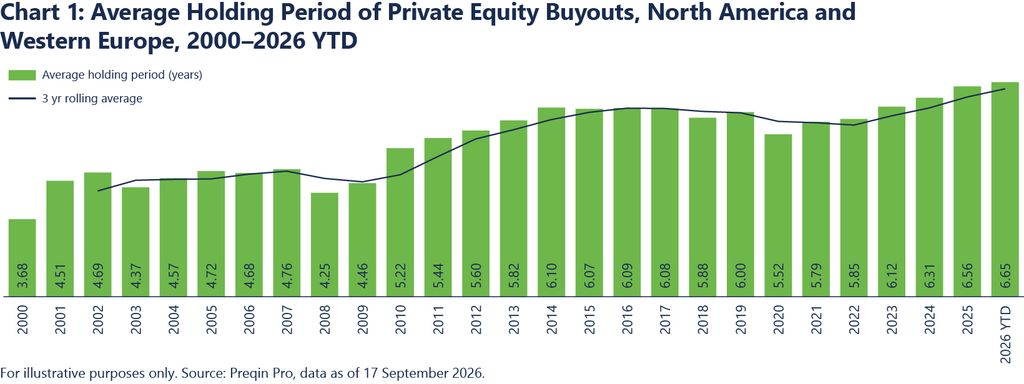
The result is an exit backlog. Private equity holds an estimated $3.8tn of unsold assets across some 32,000 companies.1 Average buyout holding periods in North America and Western Europe have risen to 6.65 years in 2026 to date, a record high and almost double the level seen in 2000 (Chart 1).2 A record 52% of PE-backed assets have been held for four years or longer, and fundraising of $616bn in 2025 was some 40% below the 2021 peak.3
Longer hold periods may often lead to calling up to 80–90% of the fund for new investments within the investment period, leaving little liquidity to provide future growth and development capital, which is becoming increasingly fundamental in this long-hold paradigm.
NAV financing helps bridge that gap, providing capital for additional M&A, resetting capital structures, and alternatives to continuation vehicles keeping performing assets within the fund.
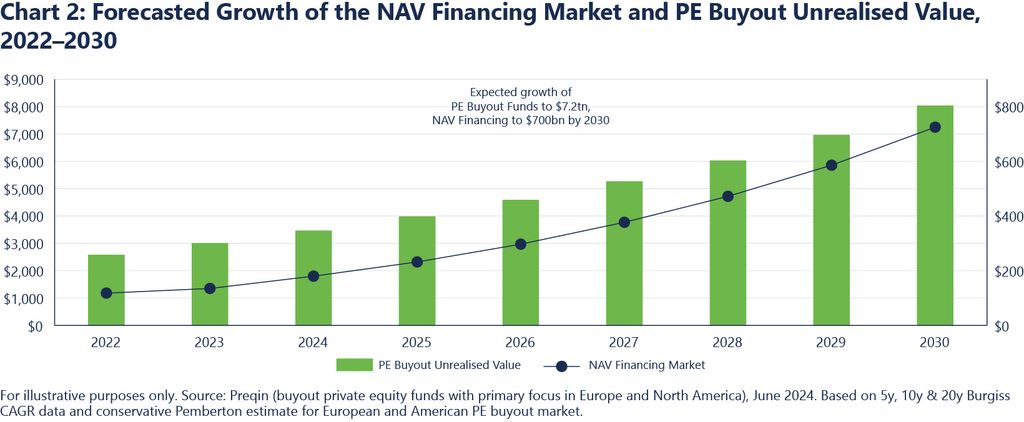
We believe NAV financing’s growth is structural, with estimated NAV adoption among private equity funds at 10-20% today, against 80-90%+ for subscription lines4, having taken a decade to become standard. Chart 2 shows the scale of the potential opportunity: the NAV financing market is projected to reach around $700bn by 2030, growing faster than the buyout portfolios it lends against.5
What is NAV Financing?
A net asset value (NAV) loan is made to a fund, usually via a special purpose vehicle (SPV), with no recourse to the fund itself but secured against the cash distributions (derived from full or partial company sales, refinancings or distributions) from the underlying portfolio companies. For an investor, repayment of the loan is predicated on the performance of a cross-collateralised portfolio of companies rather than any single business.
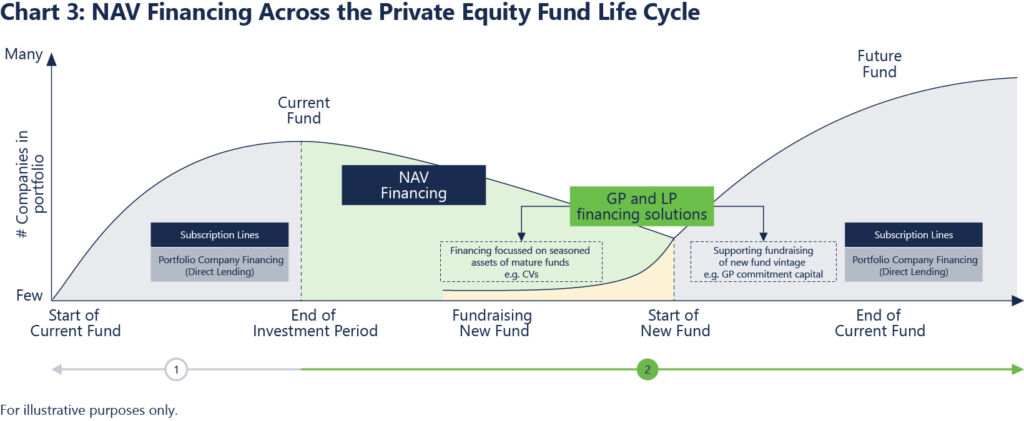
NAV financing lends against a seasoned portfolio, typically after the investment period has ended. It is the natural successor to subscription lines, which are secured on uncalled commitments while a fund still owns few assets; once those commitments are drawn, the portfolio becomes the collateral. Chart 3 shows where each product sits in a typical fund lifecycle.
5. Based on 5y, 10y & 20y Burgiss CAGR data and conservative Pemberton estimate for European and American PE buyout market.
Use Cases: What the Proceeds Finance
NAV financing can be categorised into two major use cases depending on the use of proceeds: i) growth-oriented applications and ii) defensive applications.
Growth-Oriented Applications
- Finance transformational or bolt-on portfolio acquisitions.
- Acquire additional portfolio companies towards the end of the investment period (solve for recycled capital deployment given elongated hold periods).
- Proactive optimisation of fund-level and portfolio company leverage.
Defensive Applications
- Protect against dilution of equity interest.
- Liquidity to support portfolio investments.
- Facilitate dividend recapitalisations – support performance returns.
When proceeds stay in the portfolio, they finance the companies that form the collateral: new platform investments, bolt-ons, refinancing of existing debt, or capital to support portfolio company opex/capex initiatives. Without NAV financing solutions, a GP may have to pass on value-accretive investments, that could ultimately drive fund performance/investor returns. These use cases are often leverage neutral or de-leveraging in nature, given the value creation they drive.
Defensive applications can allow GPs to limit value erosion for their LPs where a strong thesis remains but a portfolio company is navigating a challenging period or market backdrop. Ensuring the GP’s ability to follow its money in situations where there is more than one shareholder or injecting liquidity to support a business which is temporarily underperforming are relevant scenarios when a GP could consider putting in place a NAV facility.
Beyond that, NAV financings can be put in place to crystalise fund performance and distribute proceeds to LPs, which in turn can be important in the context of fundraising and investor relations generally. We turn to this in the next section.
Longer Hold Periods and the Search For Liquidity: Continuation Vehicles and DPI-Focused NAV Loans
Slower M&A activity after the post-Covid deal rush through to early 2022 has meant that sponsors have turned to alternative routes to create liquidity for their investors. Between 2022 and 2024, sponsors used NAV loans to fund distributions and increase distributions to paid-in capital (DPI) metrics. This tool has at times received criticism from some LPs in the underlying private equity funds.
Continuation vehicles (CVs) have also emerged as a key tool for providing liquidity to LPs while giving sponsors time to pursue their investment theses without a sale to an external buyer. Around 15% of sponsor exits by value are now completed through a CV6. As these options have matured, LPs have increasingly encountered both CV transactions and distributions funded by NAV loans. Over the past 24 months, CVs have become a mainstream tool, yet only 10-15% of existing LPs roll into the CV structure7. We see that limited participation as a reason to examine the value offered to existing LPs. In our view, concerns about CV economics could support a resurgence in NAV loans used to fund distributions to LPs.
Although acquisitions, follow-on investments and refinancing now account for most of the NAV financing demand we see, providing liquidity to a fund’s investors remains a legitimate application. Early and transparent engagement with LPs is central to that use: a NAV facility can return capital to fund investors while each retains its full exposure to the portfolio.
Structuring Considerations
Loan-to-value (LTV) is usually the first measure investors examine. NAV loans to private equity funds are commonly made at around 10-20% of portfolio value, with maximum LTV covenants often set at 30-40% LTV. The fund’s equity, typically 80-90% of portfolio value, sits beneath the loan, so the value of the underlying portfolio would need to fall substantially, and across many companies, before the loan itself was impaired.
Although NAV loans are bespoke, most share a common set of structural features:
- Cross-collateralisation: The loan is secured on a pool of companies, usually through an SPV, rather than on a single company.
- Priority cash sweeps: Realisations repay the loan ahead of equity, at levels set by LTV, number of companies and time to maturity, preserving collateral diversity.
- Pricing ratchets and accelerated repayments: Both step up as risk increases, helping to shorten the loan’s life in a downturn.
Together, these features explain why NAV loans can carry an investment-grade risk profile even though the individual companies in the pool would typically be rated sub-investment grade. A growing share of NAV loans are externally rated, and diversified, low-LTV facilities can achieve investment-grade ratings. For investors, this can offer investment-grade credit risk with returns commensurate with sub-investment grade returns, given the premium applied to reflect the complexity and illiquidity of the asset class. The main risks are valuation, correlation and exit timing, since private equity NAVs are appraisal-based and slower exits can extend a loan’s life.
A NAV lending portfolio is a portfolio of portfolios, with diversification at two levels. Within each loan, collateral typically comprises a cross-collateralised pool of seasoned companies spanning different sectors and geographies. Across the lending portfolio, exposure is spread by transaction, sponsor and sector, with concentration limits intended to prevent any single facility, sponsor group or industry from dominating. For illustration, 15 loans secured on 10 companies each would provide exposure to 150 underlying businesses. Priority cash sweeps help preserve collateral diversity as companies are sold.
Key Reasons Why LPs are Allocating to NAV Financing Strategies
For LPs, NAV financing can fit within different allocation buckets depending on their objectives, typically illiquid investment grade or illiquid fixed income.
- Investment grade risk profile: compelling risk-adjusted returns.
- Substantial equity buffers: 80-90% first loss equity tranche.
- Diversification: across sponsors, sectors and geographies.
- Cross-collateralised: seasoned pool of assets with limited blind pool risk.
- Priority cash flow sweeps: mitigating downside risk.
- Alternative route to access the private equity ecosystem: secured lending rather than equity ownership, with credit exposure to the underlying portfolios.
About Pemberton’s GP Solutions Franchise
Scaled, Global GP Solutions Platform
One of the largest European-owned NAV Financing lenders, supported by a dedicated team in London and New York and a broader credit platform with $34.0bn AUM8.
Deep GP Origination Network
Relationships with 275+ PE sponsors, with financing provided to 100+ sponsors across strategies. This provides significant proprietary sourcing and breadth of opportunity.
Strong LP Connectivity
Relationships with approximately 1,000 LPs globally and capital managed for 365+ investors, supported by partnerships with major institutional LPs such as ADIA
Differentiated Underwriting Capability
Combining bottom-up credit re-underwriting of individual portfolio companies with top-down portfolio analysis, enabling structures and repayment protections to be tailored to the underlying collateral.
Alignment Through Independence
Pemberton is management-owned, with Legal & General Group plc as a significant minority shareholder, and has no competing in-house private equity, distressed or loan-to-own strategy. This positions the business as aligned with GP clients rather than competing with them.
Download The Longer-Hold Era and the Investment Case for NAV Financing
For further information or if you have a specific query,
please get in touch.

Disclaimer:
This document references the Pemberton NAV Financing Strategy and is intended only for the person to whom it has been delivered. This document is solely for discussion / information purposes only and does not constitute an offer or a firm commitment of any kind to provide any investment opportunity, fund structure or return. It should only be used for evaluation of any facts presented herein.
Investments in instruments that the strategy may reference are likely to be long-term and of an illiquid nature. Such instruments are also likely to involve an above average level of risk. This document does not purport to identify all of the risk factors associated with any exposure to such a strategy and prospective investors should make their own assessment of any risk involved in seeking exposure to the strategy or instruments referenced therein. There is no guarantee of trading performance and past or projected performance of the strategy or instruments referenced is no indication of current or future performance / results. The value of investments may fall as well as rise.
Exposure to the strategy is suitable only for sophisticated investors and requires the financial ability and willingness to accept for an indefinite period of time the risks and lack of liquidity inherent in the strategy or instruments referenced therein.
Any third-party information (including any statements of opinion and/or belief) contained herein is provided by Pemberton Asset Management group of companies, being Pemberton Asset Management S.A., Pemberton Capital Advisors LLP and any other affiliates (“we”, “our” or “us”) and has not been independently verified.
Statements of opinion, market or performance information and any forecasts or estimates contained in this document are prepared on the basis of assumptions and conclusions reached and are believed to be reasonable by us at the time.
No representation, warranty, assurance or undertaking (express or implied) is given (and can therefore not be relied upon as such), and no responsibility or liability is or will be accepted by us or any of our affiliates or our respective officers, employees or agents as to the adequacy, accuracy, completeness or reasonableness of the
information, statements and opinions expressed in this document. Any opinions expressed in this document do not constitute legal, tax or investment advice and can therefore not be relied upon as such. Please consult your own legal or tax advisor concerning such matters.
The information contained in this document (which does not purport to be comprehensive) is believed to be accurate only at the date of this
document and does not imply that the information herein is correct at any time subsequent to the date hereof and such information is subject to change at any time without notice. The views expressed herein are subject to change based on market and other conditions and we give no undertaking to update the information, to reflect actual events, circumstances or changes in expectations or to provide additional information after its distribution, even in the event that the information becomes materially inaccurate.
The recipient acknowledges and agrees that no person has, nor is held out as having, any authority to give any statement, warranty, representation, assurance or undertaking on our behalf in connection with any potential investment. No part of this document may be reproduced in any manner without our written permission.
This document has been prepared and issued for use in the UK and all countries outside of the European Union by Pemberton Capital Advisors LLP. Pemberton Capital Advisors LLP is authorised and regulated by the Financial Conduct Authority (“FCA”) and entered on the FCA Register with the firm reference number 561640 and is registered in England and Wales at 5 Howick Place, London SW1P 1WG, United Kingdom. Registered with the U.S. Securities and Exchange Commission as an investment adviser under the U.S. Investment Advisers Act of 1940 with CRD No. 282621 and SEC File No. 801-107757. Tel: +44(0) 207 993 9300.
This document has been prepared and issued for use in the European Union by Pemberton Asset Management S.A. Pemberton Asset Management S.A. is authorised and regulated by the Commission de Surveillance du Secteur Financier (“CSSF”) and entered on the CSSF Register with the firm reference numbers A1013 & A1342 and is registered in Grand Duchy of Luxembourg
at 70 route d’Esch, L 1470. Pemberton reports to the US. Securities and Exchange Commission as a reporting exempt investment adviser under the U.S. Investment Advisers Act of 1940 with CRD 282865 and SEC File No. 802-107832. Tel: +352 26468360
This material is being distributed/issued in the Middle East by Pemberton Capital Advisors LLP (DIFC Branch) (“PCA DIFC”). PCA DIFC is regulated by the Dubai Financial Services Authority (“DFSA”). This document is intended only for Professional Clients or Market Counterparties as defined by the DFSA and no other person should act upon it.
Footnotes:
- 1. Bain & Company, Global Private Equity Report 2026.
- 2. Preqin Pro, data as of 17 September 2026.
- 3. McKinsey & Company, Global Private Markets Report 2026.
- 4. Based on Pemberton’s understanding of the market.
- 5. Based on 5y, 10y & 20y Burgiss CAGR data and conservative Pemberton estimate for European and American PE buyout market.
- 6. GCM Grosvenor, The GP-Led Continuation Vehicle Market: Which Platforms and Strategies are Positioned to Succeed, May 2026.
- 7. Financial Times using data from Houlihan Lokey, July 2025.
- 8. As of 30 June 2026. Assets under management are defined as committed capital.